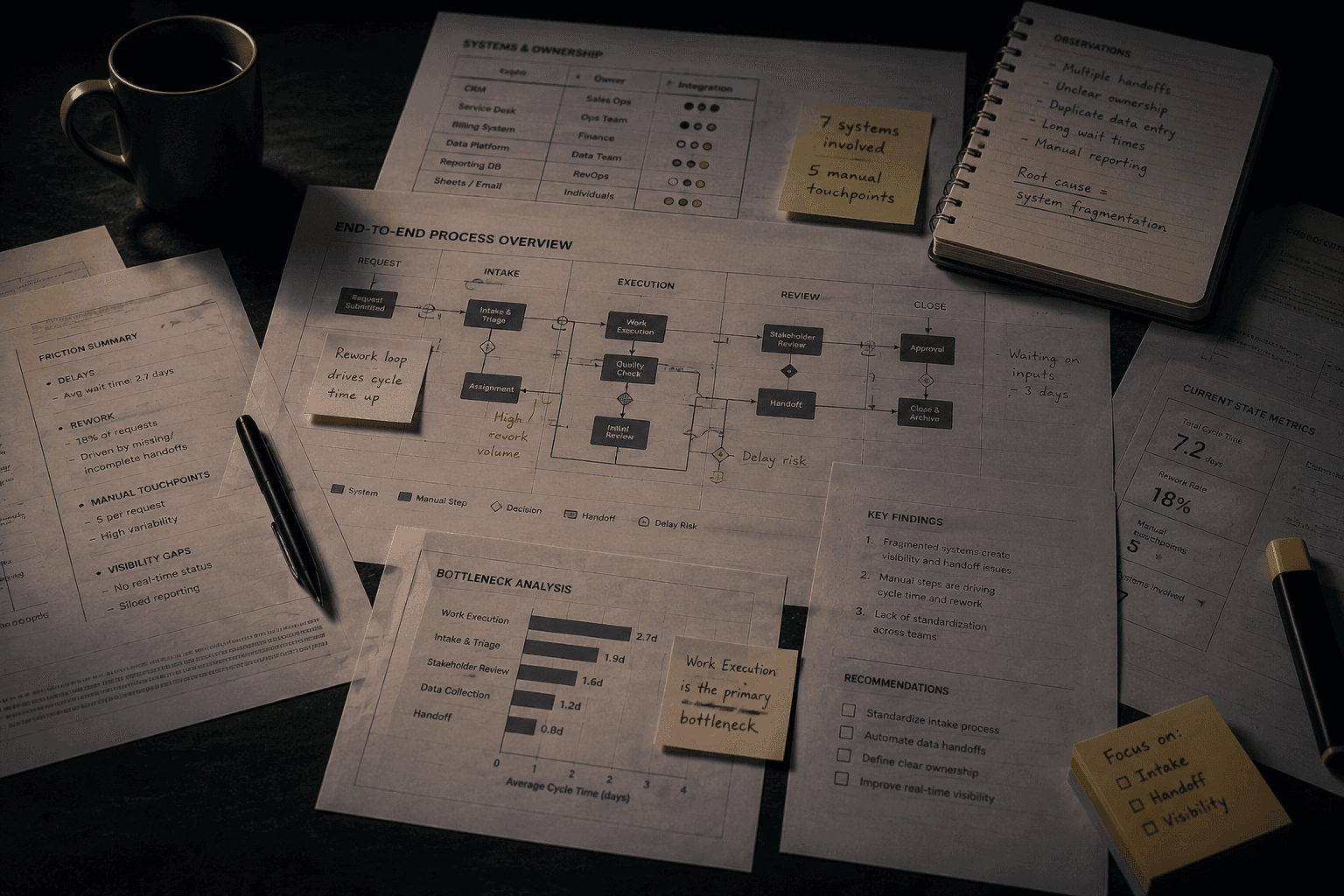
The process depends on memory.
Someone knows what happens next, but the system does not.
Operational infrastructure. Real results.
We remove workflow friction, eliminate operational inefficiency, and connect your systems so your organization can operate with clarity and scale.
The operation is working.
It just depends on too many things that were never designed to hold it together.
The process depends on memory.
Someone knows what happens next, but the system does not.
The handoff depends on availability.
Work moves when the right person notices, replies, or checks.
The report depends on assembly.
The number exists only after someone gathers it from the places it lives.
What changed
Pattern recognition without implementation consequence is analysis. Here is what changed.
Our model
A proven process that connects systems, removes friction, and creates compounding operational impact.
See the full process →We map the real operational flow, dependencies, bottlenecks, and hidden coordination patterns.
We architect systems that reduce friction and create operational visibility.
We integrate automation, infrastructure, and workflow alignment directly into operations.
We refine performance, visibility, and organizational responsiveness over time.

Operational focus
We prioritize how work actually moves before tooling or automation.
Systems thinking
We connect dependencies, owners, and handoffs into one visible pattern.
Measurable outcomes
We define leading indicators so progress is visible, not subjective.
Compounding change
We build infrastructure that improves as usage grows—not one-off projects.
Who we work with
We work with organizations where growth has exposed dependency, rework, slow handoffs, and fragmented systems.
Fit indicators
NEXT STEP
We’ll map your operational reality and identify the infrastructure that creates clarity, velocity, and scale.
No sales pitch
This is a working session, not a pitch.
Strategic conversation
We’ll understand your context and key challenges.
Clarity on next steps
You’ll leave with a clear view of what to focus on.